
Applications such as large warehouses, food production and packaging facilities are notorious for humidity issues. These types of open spaces often contain multiple areas that have different humidity needs.
As a solution, most warehouses use a standard industrial humidity control system to provide uniform control in the space. However, this may not be the best solution, as a one-size-fits-all installation is unable to meet the varying demands, resulting in increased energy bills and reduced product quality.
One way to counteract this is known as “humidity zoning”. In large industrial applications, separate areas of buildings serve different purposes. For example, there may be production, packaging, and storage areas, which require different humidity levels to keep processes operating smoothly. By using humidity zoning, areas that need more or less humidity can be adjusted, giving facility managers accurate control over the environment.
Why Do Industrial Warehouses or Facilities Suffer From Humidity and How Do You Control It?
Many factors can affect the internal climate of large facilities, like equipment, air temperature, multiple entry points, ventilation systems, and external air humidity levels.
So how do we control this? First, we need to look at the space to identify the problem zones and to illustrate, we will be using a printing warehouse as an example with two distinct areas
- The printing zone
- A storage zone
Printing Warehouse Floor Plan
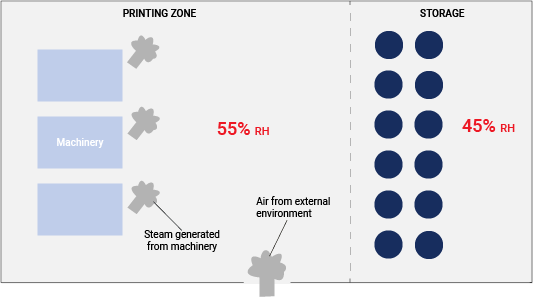
We can see from the picture, that the printing zone needs a higher level of humidity in comparison to the storage area. Now we need to consider the other factors affecting the air moisture levels, like the printing machinery releasing excess steam into the air, and the doorway allowing outside air to flow inside.
After identifying the problem areas and calculating the relative humidity, we can then decide on the equipment and which areas the industrial humidification system should cover.
In theory, we now have full control over the humidity levels of the printing facility.
What Industries Need Precise Humidity Control?
As seen from the example, customised humidity systems are a more effective method of humidity control, with many industries already using this type of solution in their businesses. Here are some examples:
- Food processing facilities often contain areas for drying food and other zones for preservation. Controlling humidity in this type of environment is vital to avoid attracting mould and food spoilage
- Printing facilities with low humidity levels can experience equipment malfunction caused by paper becoming wavy and jamming machine feeds. Another common issue is static electricity caused by dry conditions, which can adversely affect print quality. By increasing humidity levels managers can reduce both static and paper curling problems. In contrast, storage and packaging areas need slightly different conditions to protect items from getting damaged by excess moisture.
- Electronic production facilities need a dust-free environment. Dry environments can cause static, attracting dust and foreign particles to build up, eventually damaging electric circuits. Higher humidity levels can help reduce the static in these production areas. But on the contrary storage areas risk corrosion and can benefit from lower humidity levels.
- Manufacturing plants that produce, package, and store items under one roof can suffer from unstable air conditions. By actively monitoring the air quality, facilities can prevent excess moisture from damaging equipment and raw materials.
- Indoor Farms within the agriculture sector require precise climate conditions for the different stages of the plant life cycle. From germination to growth, humidity control is vital for maximum yield in a short space of time.
What Does a Custom Industrial Humidification System Look Like?
High pressure water systems are used for customising industrial humidity zones. They are currently the only type of humidifying system used for accurate humidity zone control in an open space. Let’s cover some of the main components including:
- The Controller is the hub that controls all unit operations for each zone
- Humidity Sensors are used for monitoring the relative humidity in targeted zones. Placing them in the space provides continuous feedback to the main hub (this would either be the system controller or the Building Management System). Room humidity sensors also allow direct access to the System Controller.
- Cold Water Humidifiers can disperse moisture both in duct and in-room. This will depend on a facility’s infrastructure. Each zone will have its unit specifically tailored to the environment.
- BACnet MS/TP Communication allows for seamless integration with existing Building Management Systems (BMS)
How Does Upgrading to a Custom Humidification System Benefit Your Business?
Businesses can benefit from reduced power and water usage. This in turn leads to lower utility bills, while also increasing the lifecycle of units and components because of less wear and tear.
Humidity levels are also more accurate, which helps to stabilise environments that are sensitive to moisture levels. For example, food manufacturers can monitor air quality to prevent premature spoiling of products. Resulting in lower wastage and an increase in production levels.
Additionally, industrial zone humidification systems can either be independent or incorporated with existing AHU systems, making this a cost-effective method of humidifying an industrial space. The modular design also allows businesses to scale with ease, further future-proofing facility infrastructure.
Need Help Implementing an Industrial Humidification System for Your Business?
Upgrading an industrial humidification system can be a complex task. Especially when it comes to integrating with existing infrastructure and management systems. From the initial enquiry through to installation, and aftercare, our highly experienced team of engineers are always on hand to help.
Have a question? Then get in touch with us today to discuss your business needs.
